
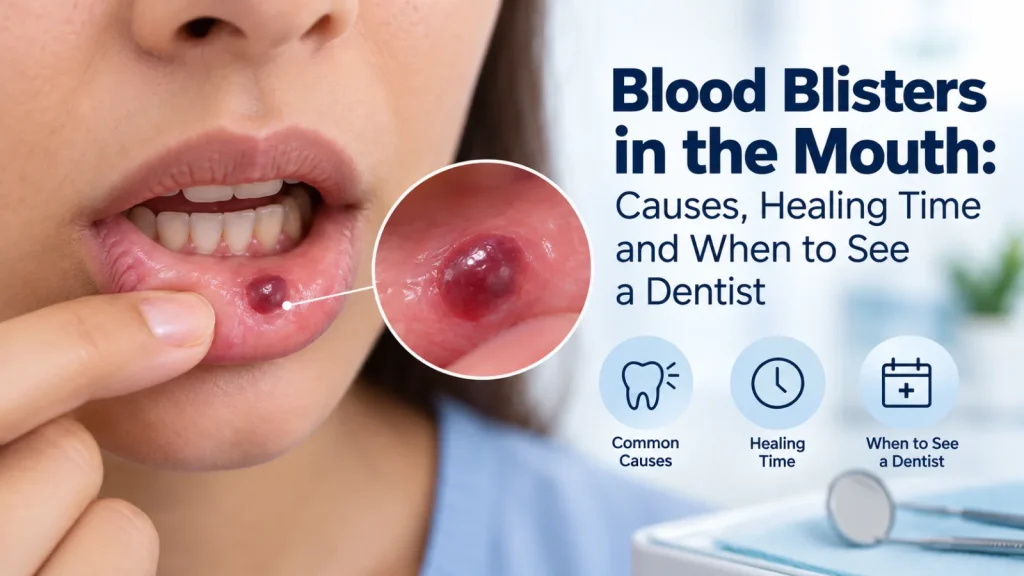
A blood blister in the mouth tends to announce itself. One moment you are eating, and the next there is a soft, dark bubble on the inside of your cheek or under your tongue that was not there before. It looks alarming, particularly because the colour ranges from deep red to purple to almost black, and because the mouth magnifies anything unfamiliar.
Most oral blood blisters are harmless and settle on their own within a couple of weeks. Some are not, and the difference matters. This guide explains what causes them, how they normally behave, what you can safely do at home, and the specific circumstances in which you should stop waiting and have the area examined.
One thing to be clear about at the outset: nothing here is a diagnosis. A dark lesion in the mouth can have several different causes that look similar to the naked eye, and only an in-person examination can tell them apart.
What a blood blister in the mouth actually is
A blister forms when the layers of the lining of the mouth separate and fluid collects in the gap. In an ordinary blister that fluid is clear. In a blood blister, a small blood vessel underneath has broken as well, so the pocket fills with blood instead. That is what gives it the dark colour.
The lining of the mouth is thin, moist and constantly moving. It is also very well supplied with blood vessels, which is why a minor injury that would barely register on your forearm can produce a visible blister inside your cheek within minutes.
The medical name you may come across for the spontaneous kind is angina bullosa haemorrhagica. It describes blood blisters that appear in the mouth without any obvious injury, usually on the soft palate, and it is a description rather than a disease in its own right.
Where they usually appear
Blood blisters are most common on the soft, mobile parts of the mouth:
- The inside of the cheeks, particularly along the line where the upper and lower teeth meet
- The inside of the lips
- Under the tongue and along its edges
- The soft palate, towards the back of the roof of the mouth
- The gums, though less often
The lip and cheek are the two most frequent sites, simply because they sit directly in the firing line of your own teeth.
What causes blood blisters in the mouth
Everyday trauma
This is the explanation in the majority of cases. Biting your cheek while eating or talking. Catching your lip during sport. A sharp piece of food, a corn chip or a fish bone, dragging across the lining. Brushing too hard along the gum line. Hot food or drink causing a small scald.
The blister often appears an hour or two after the event, by which time you may have forgotten the moment it happened.
Ongoing friction
A rough filling edge, a chipped tooth, a denture that has loosened as the ridge underneath changed shape, an orthodontic bracket or wire, or a nightguard that no longer fits properly can all rub the same spot repeatedly. Friction blisters tend to recur in the same place, which is a useful clue. If you keep getting a blister on the same patch of cheek, the cause is usually something mechanical rather than something systemic.
Dental and medical procedures
Local anaesthetic leaves the lip and cheek numb, and people bite the numb tissue without feeling it. Suction tips, impression trays and intubation during general anaesthesia can all cause minor blistering. These blisters appear within a day and resolve on the usual timeline.
Medications
Long-term inhaled corticosteroids, commonly used for asthma, are associated with more fragile oral mucosa. Blood-thinning medication does not cause blisters, but it can make a minor injury bleed more into the tissue than it otherwise would, producing a larger and darker blister. This is worth mentioning to your dentist, not because it is dangerous in itself, but because it changes what is expected.
Diet and irritants
Acidic foods, very spicy food, alcohol and some ingredients in toothpaste and mouthwash can irritate an already fragile lining. They rarely cause a blister outright, but they can aggravate one that has formed and slow the healing.
Underlying medical conditions
Less commonly, recurring oral blood blisters relate to something systemic: a low platelet count, a clotting disorder, diabetes, an immune condition, or a vitamin deficiency. This is the smaller share of cases, but it is the reason a pattern of repeated blisters with no mechanical explanation should be looked into rather than tolerated.
If your dentist suspects a systemic cause, the appropriate step is a referral to your general practitioner for blood tests. Dentists assess the mouth; they do not manage blood conditions.
How long does a blood blister take to heal?
Most oral blood blisters follow a predictable pattern.
| Stage | What happens |
| Days 1 to 2 | The blister is at its most obvious and most tender. It may be raised enough to catch on your teeth. |
| Days 3 to 5 | It usually ruptures on its own, either while you are eating or overnight. What is left behind is a shallow, red or greyish patch that can be more uncomfortable than the blister was, because the protective covering has gone. |
| Days 5 to 10 | The raw area covers over. Discomfort fades. Eating becomes normal again. |
| Days 10 to 14 | The tissue returns to its usual appearance. The mouth heals faster than skin, which is why a similar injury on your hand would still be visible at this stage. |
That is the typical course. Larger blisters, blisters in areas that move constantly such as under the tongue, and blisters in people who smoke or who have a dry mouth can all take longer. Healing time is a general pattern, not a promise, and yours may differ.
Caring for a blood blister at home
Do not pop it. This is the single most useful instruction in this article. The blister roof is a sterile biological dressing over an open wound. Piercing it with a pin, a fingernail or a toothpick introduces bacteria into a warm, moist environment and turns a self-resolving problem into a possible infection. Let it rupture on its own.
Beyond that, the aim is to leave the area alone and reduce anything that irritates it:
- Rinse gently with warm salt water. Half a teaspoon of salt in a cup of warm water, two or three times a day, swirled rather than swished forcefully.
- Eat soft and cool. Yoghurt, smooth soups that have cooled, scrambled egg, pasta. Cold foods are more comfortable than hot ones.
- Avoid the obvious irritants for a week or so: crusty bread, chips, citrus, tomato, chilli, vinegar, very hot drinks and alcohol.
- Keep brushing, but work around the area with a soft brush. Stopping oral hygiene altogether makes things worse.
- Consider a milder toothpaste. Some people find that toothpastes containing sodium lauryl sulfate aggravate a healing area. If your blisters recur, this is worth testing.
- Chew on the other side while the area settles.
For pain relief, speak to your pharmacist or doctor. We are not able to recommend specific medicines or doses through a webpage, because what is suitable depends on your medical history and anything else you are taking.
When to see a dentist
Book an examination if any of the following applies:
- The blister has not healed after two weeks
- Blisters keep returning, in the same place or in different places
- The blister is large, or is interfering with eating, speaking or swallowing
- There is no explanation for it, and no memory of biting or injuring the area
- The area bleeds persistently or reopens repeatedly
- You have several blisters at once, or blisters alongside bruising elsewhere on your body
- The patch has changed colour, thickened, hardened, or developed a raised or irregular edge
- You are unwell in yourself: fever, fatigue, unexplained weight loss
The two-week rule is the important one. Any lesion in the mouth that has not resolved within two weeks should be examined by a dental or medical practitioner. That is not because it is likely to be serious. It is because the small number of conditions that are serious are far more treatable when they are found early, and a two-week threshold is a simple, reliable way to catch them without living in a state of alarm about every sore spot.
Seek immediate medical attention if a blister or swelling is affecting your breathing or your ability to swallow, or if it is at the back of the throat and enlarging. That is an emergency department situation, not a dental appointment.
What happens at the appointment
An assessment is straightforward. Your dentist will ask when you first noticed the area, whether it has changed, whether it has happened before, and what medications you take. They will examine the mouth, including the areas you cannot easily see yourself, and check the teeth, fillings, dentures or appliances nearby for a rough edge or a fit problem that would explain recurring friction.
From there, the outcome is usually one of three things. The lesion is identified as a straightforward blood blister, in which case you are advised on care and left to heal. A mechanical cause is found, in which case smoothing a sharp edge or adjusting a denture removes the trigger. Or the appearance is not typical, in which case further investigation or referral is arranged.
Where treatment is appropriate, one option available at our clinics is blood blister removal using a dental laser. Whether a laser is suitable depends on the size, site and nature of the lesion, and that can only be determined after an examination. It is not the right approach for every blister, and it is not a substitute for identifying why the blister formed.
Blood blister, ulcer or something else?
Several things in the mouth look similar at a glance, and people frequently arrive having assumed the wrong one.
| Condition | How it differs |
| Mouth ulcer | A shallow crater with a white or yellow base and a red rim. Usually more painful than a blood blister, and it does not start as a fluid-filled bubble. |
| Cold sore | Typically on the outer lip or around the mouth rather than inside it. Begins with tingling, then forms a cluster of small blisters that crust over. |
| Mucocele | A soft, dome-shaped, bluish swelling, most often on the lower lip. Forms when a minor salivary gland duct is damaged and saliva collects. Tends to come and go over weeks and often needs treatment to resolve properly. |
| Haematoma | A collection of blood within the tissue rather than in a blister cavity. Flatter, firmer, and does not rupture. |
| Pigmented patch | Flat, painless area of colour. Sometimes normal, sometimes worth investigating. |
Telling these apart from a description is unreliable, which is the point. If it has not gone in two weeks, have it looked at.
Reducing the chance of it happening again
If your blisters are trauma-related, a few practical changes help. Eat more slowly, particularly if you are prone to cheek biting. Have a rough filling or chipped tooth smoothed rather than living with it. Have dentures checked for fit, since the ridge underneath continues to change over the years. Wear a properly fitted mouthguard for contact sport. If you grind or clench at night, an assessment for a nightguard is worth having, because clenching pulls the cheek between the teeth.
If you use an inhaled steroid, rinsing your mouth with water after each dose is standard advice from asthma educators and is worth following.
And if the blisters keep coming back with no clear mechanical cause, mention it to both your dentist and your general practitioner. Recurrence is the signal worth acting on.
Frequently asked questions
Should I pop a blood blister in my mouth?
No. The blister roof protects the wound underneath and reduces the risk of infection. It will usually rupture on its own within a few days, and the area heals from there.
How long does a blood blister in the mouth take to heal?
Most settle within one to two weeks. Larger blisters, or blisters in areas that move a lot such as under the tongue, may take longer. If it has not healed after two weeks, have it examined.
What causes blood blisters in the mouth?
Most are caused by minor trauma, such as biting the cheek or catching the lip on a sharp piece of food. Ongoing friction from a rough filling, a chipped tooth or a denture is another common cause. Less frequently, medications or an underlying medical condition are involved.
Is a blood blister in the mouth serious?
Usually not. The ones that need attention are those that persist beyond two weeks, recur without explanation, keep bleeding, change in appearance, or affect breathing or swallowing. The last of those requires immediate medical care.
Can a dentist treat a blood blister?
A dentist can examine the area, identify a mechanical cause such as a sharp edge or an ill-fitting denture, and advise on care. Where treatment is appropriate, laser removal may be an option, depending on the size and location of the lesion.
Do blood blisters in the mouth come back?
They can, particularly when something is repeatedly rubbing the same spot. Recurring blisters with no obvious mechanical cause should be discussed with your dentist and your doctor.
Concerned about a blister that is not settling?
Our dentists at Cardiff, Fletcher and Mayfield can examine the area and talk you through what they find.
Book an appointment or call your nearest clinic.