
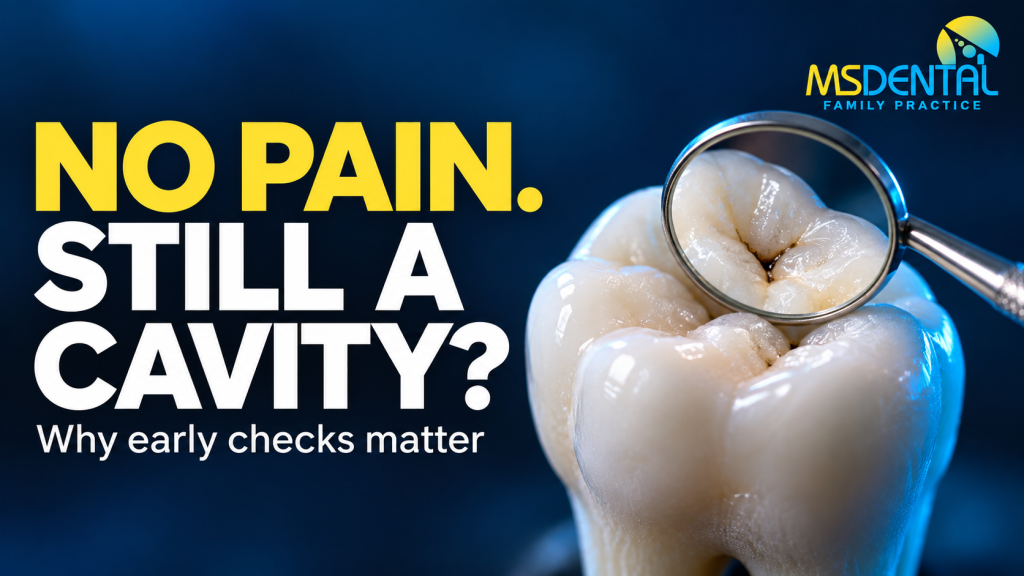
"But it does not hurt." We hear this a lot, usually just after we point out a cavity on an X-ray. And it is completely understandable. Most of us grow up thinking that if a tooth is not sore, it must be fine.
Unfortunately, tooth decay does not work that way. It is very common to have a cavity and not know it, sometimes for months or even years. By the time pain shows up, the decay has often travelled deep into the tooth.
So let us look at why cavities can be painless, the quiet warning signs, how dentists spot hidden decay, and why finding it early makes life (and treatment) much simpler.
In this article
- Yes, You Can Have a Cavity Without Pain
- Why Early Decay Does Not Hurt
- How Painless Decay Progresses
- Where Hidden Cavities Like to Hide
- Who Is More at Risk?
- What About Kids?
- Subtle Signs Worth Noticing
- How We Find Decay You Cannot Feel
- Why Early Detection Matters
- Lowering Your Risk
- What Happens If We Do Find a Cavity?
- Frequently Asked Questions
Yes, You Can Have a Cavity Without Pain
In its early stages, tooth decay is usually completely painless. Pain tends to arrive only once decay has worked through the outer layers and is getting close to the nerve.
Why Early Decay Does Not Hurt
Think of a tooth as having three layers:
- Enamel: the hard outer shell. It has no nerves, so decay here causes no sensation at all.
- Dentine: the softer layer underneath. It has tiny channels leading to the nerve, so decay here may cause occasional sensitivity, but not always.
- Pulp: the centre of the tooth, with the nerve and blood supply. When decay reaches or irritates the pulp, pain usually kicks in.
Decay starts when bacteria in plaque turn sugars into acid, which slowly dissolves enamel. Because enamel has no nerves, this can go on quietly for a long time.
How Painless Decay Progresses
- Stage 1, early mineral loss: chalky white spots appear. At this point decay can sometimes be reversed with fluoride and better habits.
- Stage 2, enamel cavity: a small hole forms. Usually still painless.
- Stage 3, dentine decay: decay spreads faster through the softer layer. Some people notice sensitivity, others feel nothing.
- Stage 4, pulp involvement: toothache, lingering sensitivity or pain when biting.
- Stage 5, abscess: infection spreads beyond the root, often with swelling and severe pain. This needs urgent care. healthdirect lists the warning signs.
Here is a twist many people do not know: a tooth can stop hurting after a bout of severe pain. That can mean the nerve has died, not that the problem has gone away. The infection can still spread.
Illustrative example
The "silent" cavity
Picture a busy Fletcher dad named Mark. He brushes twice a day and has never had toothache. At his first check-up in two years, the bitewing X-ray shows a shadow between two back teeth that cannot be seen in the mirror.
Because it is caught at stage 2 to 3, Mark needs one small tooth-coloured filling. Left another year or two, that same cavity could have kept growing towards the nerve.
Where Hidden Cavities Like to Hide
- Between teeth, where two teeth touch and you cannot see
- In the deep grooves of back teeth
- Around old fillings and crowns, at the edges
- Near the gumline, especially where gums have receded
Who Is More at Risk?
Anyone can get a painless cavity, but the risk is higher for:
- Frequent snackers and sippers, especially of sugary or acidic drinks
- People with a dry mouth, which can come from some medications or mouth breathing
- People with lots of existing fillings
- People with gum recession
- People wearing braces or aligners who find cleaning tricky
- Anyone who has gone more than a year or two without a check-up
What About Kids?
Children are especially likely to have decay without complaining. Baby teeth have thinner enamel, so decay spreads quickly, and young children often cannot describe discomfort. Instead, watch for chewing on one side, avoiding cold foods, or brown or white marks on teeth.
And no, decay in baby teeth is not "fine because they fall out". Baby teeth hold space for adult teeth, and infection can affect the adult tooth developing underneath. Learn more about children's dentistry, when kids should see a dentist, and how healthdirect recommends caring for children's teeth. Eligible families may be able to use the Child Dental Benefits Schedule.
Subtle Signs Worth Noticing
Even without pain, there can be clues:
- Brief sensitivity to sweet, hot or cold foods
- A white, brown or black spot on a tooth
- A rough edge or tiny hole your tongue keeps finding
- Food catching in the same spot
- Floss that shreds between certain teeth
- Persistent bad breath or a bad taste
Our blog on dental health and bad breath explains the link.
How We Find Decay You Cannot Feel
At a dental examination at MS Dental, we use:
- A close visual check with good lighting
- Dental X-rays, which reveal decay between teeth and under old fillings
- A risk review of your diet, saliva, past decay and home care
That is why regular check-ups still matter when your teeth feel perfectly fine.
Why Early Detection Matters
| Stage found | Typical approach |
|---|---|
| Early white spot | Fluoride, monitoring and habit changes |
| Small cavity | A small filling |
| Larger cavity | A larger filling, or sometimes a crown |
| Decay reaching the nerve | Root canal treatment, often with a crown |
Each step means more time and more cost. For typical fees, see How Much Does a Tooth Filling Cost in Newcastle? Worried about root canals? Read Is Root Canal Painful?
Lowering Your Risk
- Brush twice a day with fluoride toothpaste, and spit rather than rinse
- Clean between your teeth daily
- Keep sugary foods and drinks to mealtimes
- Choose tap water
- Ask whether fissure sealants suit you or your children
More on diet in sugar and tooth decay in Australia.
What Happens If We Do Find a Cavity?
First, take a breath. Finding a cavity early is good news, because it usually means simpler treatment. At MS Dental, we will:
- Show you the cavity on your X-ray or intraoral photo, so you can see exactly what we see
- Explain whether it needs treatment now or can be monitored
- Give you a written plan with item numbers and costs
- Book the treatment at a time that suits you
For very early changes, we may recommend fluoride and a review rather than a filling.
Frequently Asked Questions
Can a cavity heal on its own?
Only the very earliest stage, before a hole forms. Once a cavity has formed, it needs treatment.
Why did my tooth stop hurting?
It may mean the nerve is dying. Please see a dentist promptly. Our emergency dentist service can help.
Nothing Hurts? Great. Let Us Keep It That Way.
Pain is not a reliable warning system for tooth decay. A quick check-up is the simplest way to know what is really going on, and to fix small things while they are still small.
Refer a friend to MS Dental and you could both receive a 10% discount on your next appointment (minimum spend $300, discount capped at $50, one discount per patient, the new patient redeems their referral card first, and it cannot be combined with other offers). Full terms and conditions.
This article is general information only and does not replace an examination by a dentist.